West-side residents to City Hall: don’t dump the border line on our streets
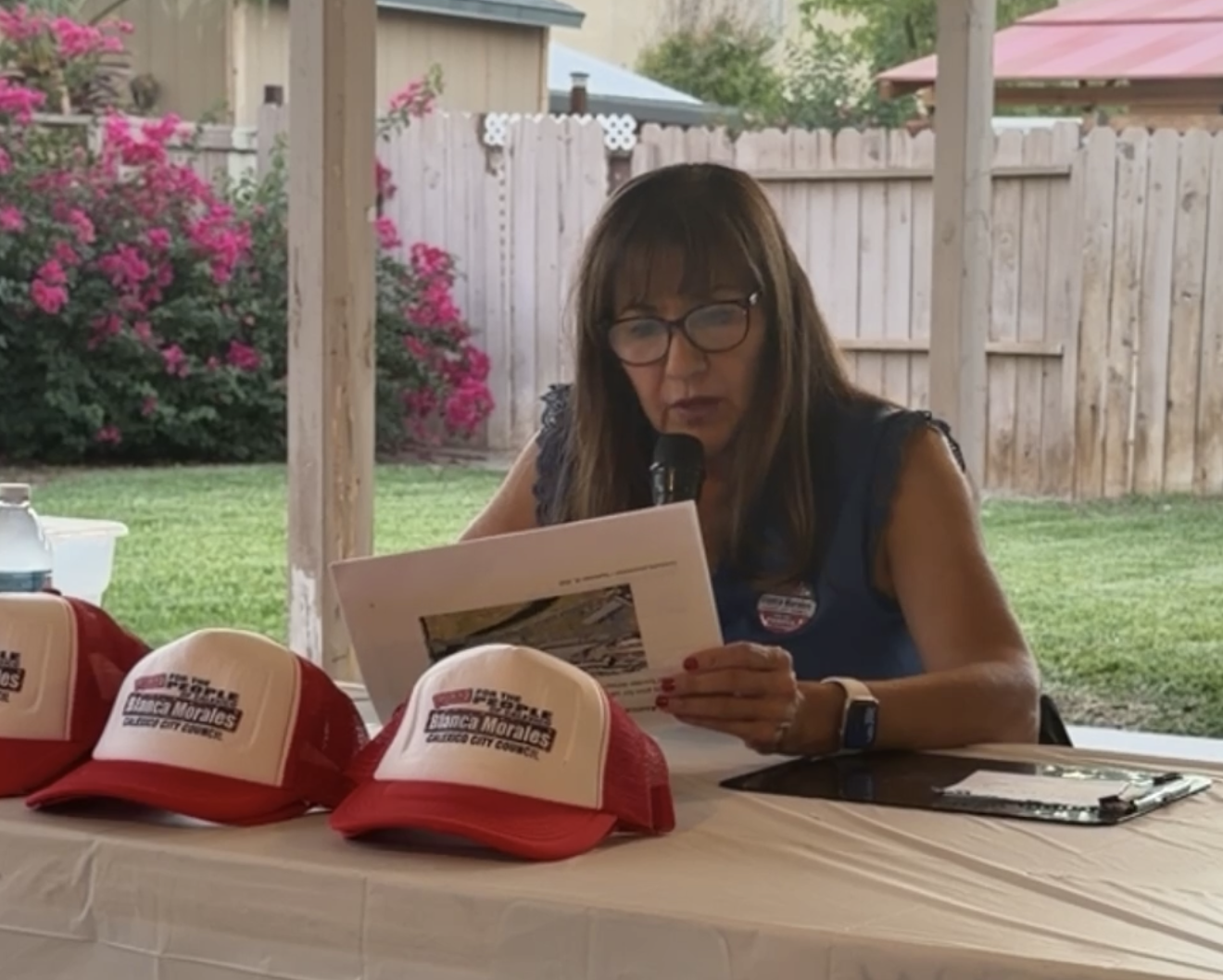
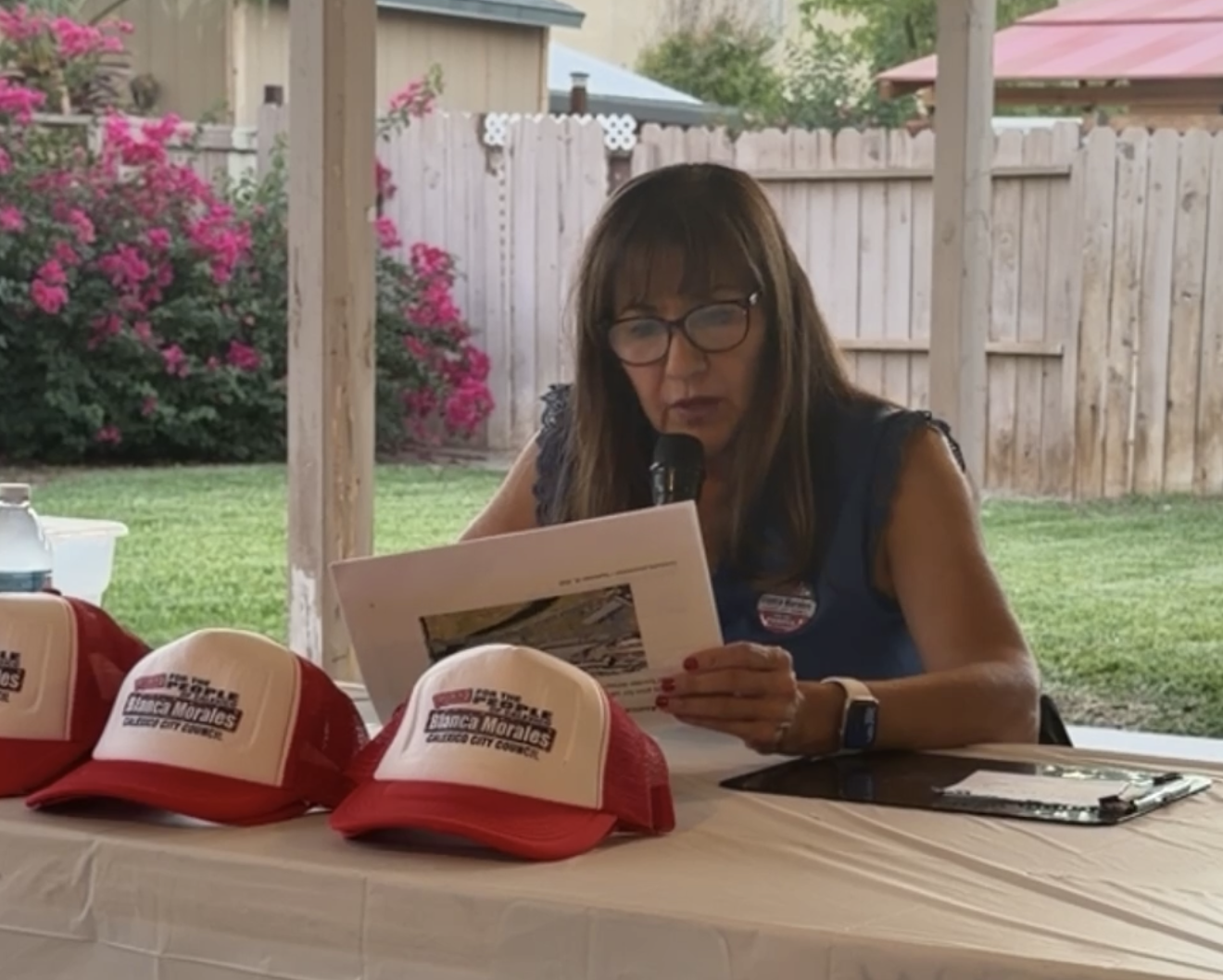
Calexico City Council Candidate, talking about the West Side of Calexico California Traffic and how it affects its residents there.
by Loret Camargo | Calexico Now
Calexico, Calif. — Sept. 30, 2026
A Wednesday night meet-and-greet on Skyline Street was billed as a conversation about west-side traffic and the Port of Entry. What it became was a warning.
Residents who live west of Highway 98 and Grant Street say a plan circulating after the Sept. 16 City Council meeting would push more southbound Mexicali-bound traffic onto their neighborhood — past homes, a park, and a school — without an economic study, without a health study, and without anyone knocking on their doors first.
City Council candidate Blanca Morales hosted the meeting. The election is Nov. 3. The argument in the room was bigger than one campaign: who pays for a federal border queue, who breathes the idle exhaust, and whether Calexico is still a town or just the pavement between Mexicali and the rest of Imperial Valley.
What Morales put on the table
Morales, who said she returned from San Diego in 2017 to open a nonprofit clinic and later chaired the downtown BID, walked the room through a packet she called a Calexico–Mexicali traffic plan.
She described two crossings. Calexico West has five southbound inspection lanes, with the approach at Second Street and Cesar Chavez Boulevard. Calexico East — “the new bridge,” in her words — only helps when the clock and the total trip make it worth the drive.
The bottlenecks, she said, are not a mystery: signals and streets on the U.S. side, inspection lanes at the line, and receiving streets in Mexicali. A real study, she argued, has to name all three.
The agencies that would have to sit at the same table, in her telling:
City of Calexico and Calexico Police — local streets, intersections, traffic controllers
Caltrans and ICTC — highways and funding
CBP and Mexican authorities — she said the military handles the Mexicali side of the port
Union Pacific — the rail crossing that shuts the west side down when a train rolls through
She said she has already spoken with the police chief and a sergeant about intersections that choke businesses off Highway 111.
She floated a 90-day pilot: first 30 days measure queues, wait times, and blocked corners; days 31–60 test signal timing and peak-hour staffing; days 61–90 compare numbers and publish a community update. Success, she said, is shorter delays and reliable access to houses, shops, and emergency routes.
She also read grant dates that, if City Hall is using them, are already tight:
Oct. 9, 5 p.m. — Caltrans Sustainable Transportation Planning Grant, possible “southbound border mobility plan,” with District 11 asked to confirm eligibility and match. Planning money, she noted, is not construction money.
Nov. 19, 2026 — congested-corridor type funding through ICTC or Caltrans.
Nov. 26 — Trade Corridor Enhancement Program nominations, especially relevant to Calexico East.
She said city records show traffic-controller and parking-enforcement staffing that still needs confirmation, and that a five-year accident pull specific to border traffic has not been verified. She said Union Pacific runs the rail gateway (Southern Pacific merged into it in 1996) and that the city already has a grade-crossing improvement agreement — the document she wants opened for delay times and emergency exits.
Those are her slides. The room did not stay on the slides.
“It was a traffic study. That’s all it was.”
The sharpest line of the night did not come from the candidate.
A west-side speaker said the work after Sept. 16 was a traffic study, not an economic-impact study and not a study of what happens to people who live here.
No one, that speaker said, asked downtown or the business corridor what a reroute does to sales. No one asked households west of the tracks what a longer southbound stack does to a school pickup, a driveway, or a night’s sleep.
If the only question on the page is “how do we move the line,” the easiest answer on a map is always the same: put the line on the west side.
That is the fight. Not whether there is a wait. Whether this neighborhood is the overflow tank.
School bells, freight horns, and a 45-minute trap
Neighbors described the weekday they already have.
The train and the line hit at the same time — 7:15 to 8:15 a.m. — when parents are trying to reach campus. After school, the queue backs toward AMPM. Drivers cut residential streets “like it’s you or me.” Holidays, they said, will make it worse.
The horns do not wait for sunrise. Residents said Union Pacific blows through at 3:30 and 4:00 a.m.
Someone asked how long a locked crossing actually lasts. Answers in the room: half an hour, 40 minutes. One story: 45 minutes, a broken train, a U-turn at the post office, then out toward Cole Road and Imperial Avenue because the local streets are too narrow to reroute that many cars. “It doesn’t happen a lot,” one person said. “When it happens, it’s chaos.”
Morales said former firefighters told her that stopping that train can cost about $20 million an hour. She offered it as the reason the railroad will not pause for drop-off. Whether the figure is a contract number or corridor folklore, the political meaning is the same: the city either designs around the tracks or it keeps treating a freight schedule like a neighborly inconvenience.
She added the detail that should end any polite version of this debate. Calexico has not had a hospital since October 1998. There is a fire station on the west side that sat closed and reopened only a few years ago. If the train owns the crossing and an ambulance needs the west side, “wait for the freight” is not a public-safety plan.
Pollution, the New River, and a port that “just got built”
West-side speakers stacked traffic on top of what they say the rest of Calexico treats as background.
They live with the New River. They talked about asthma and cancer rates in their schools and on their side of town. They said people who do not live here do not understand that map.
Now the same blocks are being asked to take more idling engines next to houses, a park, and a school.
“Imperial is not the same as residents right next to it,” one speaker said.
Someone asked how long the newer port of entry has been part of daily life. The answer in the room: about 15 years. The follow-up: when they built it, why wasn’t the river encapsulated when it sits next to the parking lot?
“They just built it,” another person said. “There was no community outreach that I remember.”
Morales did not dispute the health list. She named high local rates of cancer, diabetes, heart disease, asthma, teen pregnancy, and C-sections, and said asthma is “huge.” Her answer was process: put west-side residents on the task force, get “movers and shakers” to the table, stop only complaining.
Residents’ answer was narrower. If staff only counted cars, staff did not study this neighborhood.
Who pays for a federal line?
This is the budget argument, and it cut across the room.
Several people said Calexico should not be paying traffic controllers to babysit cars trying to leave the United States. That queue, they said, belongs to CBP, GSA, Caltrans, and CHP — not a city of about 40,000 sitting between 1.3 million people in Mexicali and a railroad.
One speaker put it as a ledger question: every dollar the city spends on controllers is a dollar that does not go somewhere else. CHP is a state agency, they said. The state should put skin in the game.
There was a second money complaint: some business owners were told they would be charged for “their portion” of traffic control while others would not. If that is how the city is writing invoices, residents said, it is not traffic management. It is picking who pays.
Morales said port construction has already made the wait worse and that GSA has to hear from a small city, not only from a ribbon cutting. She named federal and congressional names — including Steve Padilla and Rep. Raul Ruiz — as the people who need to stand on Cesar Chavez at rush hour.
San Diego, someone noted, has a border task force. In this region, they said, that idea is dormant. ICTC is the table. A resident named Adriana as Calexico’s person there.
Calexico as a bypass
Morales’s own frame is demographic.
She said Calexico was about 12,000 people in 1990 and about 40,000 now, while Mexicali is about 1.3 million. Families, dentists, restaurants, and school kids are on the other side of the line. Kids who once walked to school are driven from Mexico. The census, she argued, undercounts how many bodies actually move through town because many people listed here live in Mexicali.
The result, in her words: Calexico is what you roll over on the way to Mexicali, El Centro, Brawley, Imperial, or San Diego.
Her pitch is to make people stop — downtown, baseball, soccer, schools, the high-school tournament with Mexicali, snowbirds, farmworkers. Safety and cleanliness first.
West-side residents added the condition she cannot campaign around: you cannot sell “stop in Calexico” if the west side is the holding pen for the port.
A 29-year UPS driver was in the room. Morales pointed at that kind of local knowledge — people who already know every cut-through — and said the next generation has to be in the meetings because “we’re not going to be here forever.”
Closed parks, a stalled pool, and a grandma’s timeline
The talk slid from freight to fields, and it was not a detour.
Residents said a baseball and softball complex they grew up on is closed — “as far as I know, they never opened it.” A pool project they dated to about 2015 is still tangled in the same red tape. Kids leave for other cities’ teams. Traveling clubs cannot be told they are playing a “state-of-the-art” park in Calexico if the gates are locked.
One person described a recreation presentation on Heber Park and the park by Meadows. A staffer said they had been talking about those projects since she was a child. She is a grandmother now.
That was the setup for the only campaign question that landed.
“We’ve been talking about the traffic and the border since I got involved, and we’re still in the same boat,” the resident said. “How are you going to get the rest of council to work as a unit? A strong city government is a stronger city. Stop pointing fingers and fighting on Facebook.”
Morales said she has attended council meetings for eight years. Agendas are thick with codes and attachments. She said about 90 percent of Calexico is Spanish-speaking and the city has to translate the work into a plan, a timeline, and a named task force — including when a date like February 2027 slips.
She called for bringing back the funding commission that faded in the last couple of years, and for appointing commissioners who actually show up so meetings have a quorum. Inactive boards, she said, are how projects die. She compared it to cleaning up her own nonprofit board.
It was a management answer. It did not say how she votes if staff’s “mobility plan” is the west-side dump.

More than 70 young artists from Calexico and Mexicali opened the Youth Art Contest at the Border at the Carmen Durazo Cultural Arts Center, with 65 works on view and cash awards for the first time.