The West Side of Calexico Should Not Become the Parking Lot for Border Traffic
From Loreto Camargo | Ahora TV | Calexico Now
Is it just me — or does nobody care about the west side of Calexico?
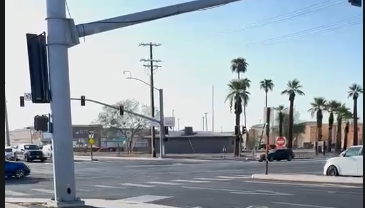
The City is considering a temporary Border Traffic Realignment that would take Mexico-bound passenger traffic off Imperial Avenue and send it west on Highway 98 — Birch Street — then south on Cesar Chavez Boulevard toward the Calexico West Port of Entry.
That traffic does not disappear. It gets transferred.
And much of that extra burden lands on the west side of town.
For years, residents have said the west side is treated like the poor side of Calexico. A temporary project that relocates an international backup onto Cesar Chavez and the neighborhoods around it is not “management.” It is a choice about who sits in the line.
The west side should not become the parking lot for an international traffic problem.
This is bigger than one street
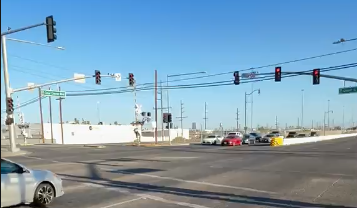
Calexico’s congestion is not only Imperial Avenue. It is not only Cesar Chavez. It is what happens when a small American city is used as the funnel for a much larger binational region.
Cesar Chavez Boulevard was already widened, in part, to give another route to the downtown Port of Entry. Agencies have studied circulation around Calexico West for years: the City, Caltrans, ICTC, and others.
The alternative presented to the public and to the City Council would channel southbound traffic heading to Mexico through Cesar Chavez. Motorists would be restricted from queuing on Highway 111 and Imperial Avenue to turn onto Second Street toward the port. Local traffic would be left on 111 and Imperial. Barriers on Cesar Chavez would shift. Turns at Second Street and Grant Street would change. Some movements would close when the queue grows.
That is a temporary operations plan. It is not a permanent infrastructure solution.
The number on the public record is $4.2 million
At the January 27, 2026 special City Council meeting, the proposed alternative — manual barrier gates, traffic control, restriping, and signage — was presented at $4.2 million overall. Calexico would be responsible for construction, inspection, and traffic control. Caltrans has oversight on state right-of-way on Highway 98 and Highway 111, so the City would work under a Caltrans encroachment permit.
During consideration of the project, a lower City engineering figure of about $1.54 million has also been discussed for a City-led version of the work. A higher Caltrans-path figure in the $4 million range matches what was put in front of the public.
Either way, the point is the same:
This is millions of dollars for a temporary traffic-management project. It is not the permanent solution.
Once funded, staff described roughly 10 months of administrative process before work, then about 140 working days of construction. That is a long “temporary.”
The west side will carry the extra load
If Mexico-bound cars leave Imperial Avenue and use Highway 98 and Cesar Chavez, the cars are still here. They are just on a different map.
West-side residents and businesses did not create the international backup. They should not be asked to absorb it so downtown and Imperial Avenue look better on a slide.
Equal treatment means:
the same traffic safety
the same emergency access for police, fire, and ambulance
the same investment in pavement, signals, and enforcement
the same quality of life
Anything less is using the west side as overflow parking for a federal crossing.
Put both sides of the border in perspective
Use the same census year.
In 2020, the Municipality of Mexicali — the city and the broader Mexicali Valley — had 1,049,792 residents.
Imperial County had 179,702.
Mexicali’s municipality was about 5.8 times the population of the entire county. Together, about 1.23 million people — and that does not count everyone who uses Calexico as a gateway to someplace else.
Do not look only at downtown Mexicali. The valley includes Los Algodones, Batáquez, Benito Juárez, Cerro Prieto, Ciudad Morelos, Colonias Nuevas, Delta, González Ortega, Guadalupe Victoria, Hechicera, Hermosillo, Progreso, Venustiano Carranza, and dozens of smaller settlements and ejidos.
Once people cross, Calexico is a gateway to Imperial Valley: Calexico, El Centro, Imperial, Brawley, Holtville, Calipatria, Westmorland, plus Heber, Seeley, Niland, Salton City, Desert Shores, Bombay Beach, Ocotillo, Palo Verde, Winterhaven, and others.
Travel continues east toward Yuma, San Luis, Somerton, and Wellton.
North toward Palm Springs, Cathedral City, Indio, Coachella, and the rest of the Coachella Valley.
West toward San Diego County and its cities.
Some people stay in Calexico. Some commute daily. Some come weekly. Calexico is not only a destination. Calexico is an international gateway.
Agriculture and holidays are the real test
The Mexicali Valley, Imperial Valley, and Yuma region are major farm areas. Imperial Valley’s heavier agricultural period generally runs from October and November through March. In the middle of that sit Thanksgiving, Christmas, New Year’s, and three-day weekends.
When farm labor, regular commuters, shopping, and holiday travel overlap, the streets and the crossing take the hit.
Summer traffic is not the test. Congestion does not vanish in spring and summer, but a temporary realignment should not be judged only in a lighter season.
Measure queues, travel times, and emergency response from October through March and on major holidays — or do not pretend the project “worked.”
The other problem: commercial trucks
Passenger cars toward Calexico West are only half the story.
Commercial trucks do not use the downtown West Port for international freight. The major commercial crossing is Calexico East, on State Route 7, which runs from the East Port north to Interstate 8. Caltrans describes the East Port as handling passenger and commercial vehicles. GSA describes Calexico West as a non-commercial land port.
That does not spare Calexico. Trucks still roll on:
Highway 98, east and west
Highway 111, north and south
Cole Road
the eastern network toward SR-7 and the East Port
Commerce is year-round. Agriculture has a season. Holidays have a season. Trucks do not take the summer off.
A semi-truck is not a sedan. It changes capacity, turning movements, pavement wear, safety, noise, diesel emissions, and emergency response. Those conflicts happen on the same small network as school traffic, shoppers, and west-side residents.
Moving passenger cars from Imperial Avenue to Cesar Chavez does nothing about trucks on 98, 111, Cole Road, and SR-7.
Calexico has two international transportation problems:
Passenger congestion tied mainly to the West Port
Commercial freight tied mainly to the East Port and the highways that feed it
A serious plan has to address both.
You can move the line. The bottleneck remains.
Restriping, barriers, banned turns, cameras, citations, and traffic controllers can manage a queue. They cannot invent inspection booths.
If vehicles arrive faster than the Port of Entry can process them, the backup appears somewhere. Moving the line does not eliminate the line.
Federal staffing and crossing capacity on both sides have to be part of the conversation. Rearranging Calexico’s streets will not fix a booth shortage in Mexicali or in Calexico.
What Calexico should demand before any millions are spent
1. A Traffic Advisory Committee
People who actually know traffic engineering, freight, agriculture, emergency response, and border operations — not only politics.
2. A standing liaison with Mexicali
When a backup starts, someone in Calexico should be able to call the right person in Mexicali the same hour. Administrations change. The phone number should not.
3. Measurements written down first
If this project is approved, publish the baseline before construction:
congestion on Imperial Avenue
added volume on Cesar Chavez and Highway 98
Second Street and Grant Street
queue length and duration
October–March and holiday performance
west-side business and resident impacts
police, fire, and ambulance times
truck counts on 98, 111, Cole Road, and SR-7
No baseline means no honesty later.
4. Tell the truth about scale
Regional plans have previously put major Port of Entry / Cesar Chavez work — including grade separation — in the hundreds of millions. One older regional estimate was about $372.5 million in 2007 dollars. The City of Calexico cannot finance that alone. This is a regional, state, federal, and binational problem.
Bottom line
Calexico is next to a municipality of about 1.05 million people. The county on this side had about 179,700 in the same census year. Commuters, farm labor, holidays, regional travelers, and year-round trucks all share a small street system.
Relieving Imperial Avenue alone is not success.
Dumping the queue on Cesar Chavez is not equity.
Spending $4.2 million — or $1.54 million — on a temporary shift is not a permanent fix.
Do not just move the traffic jam.
Do not move the parking lot from Imperial Avenue to the west side.
Address passenger traffic and commercial trucks together.
Solve the traffic problem.



The west side of Calexico should not become the parking lot for border traffic. A temporary plan would move the jam from Imperial Avenue to Cesar Chavez — without fixing the Port of Entry or the trucks.